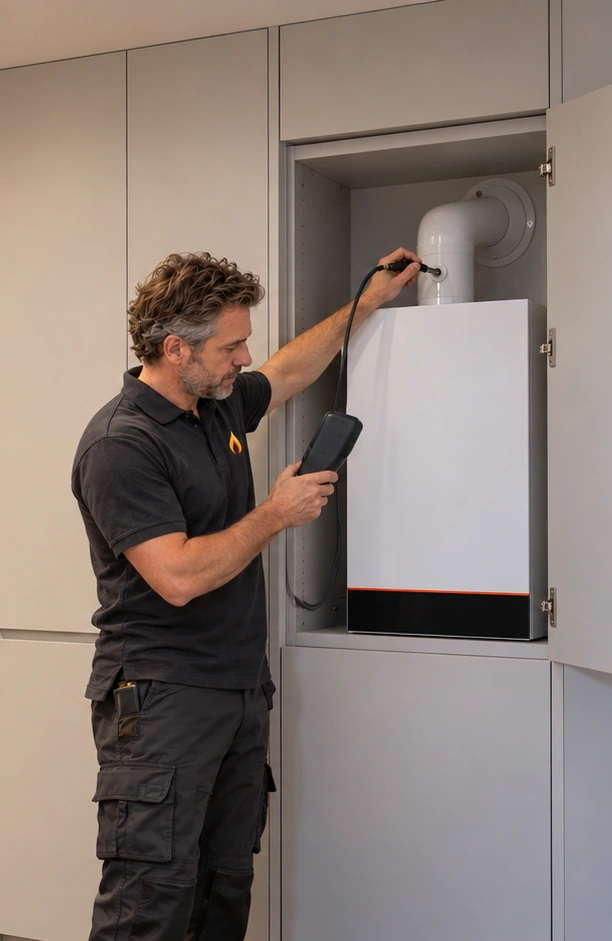

Viessmann boiler repair in London
We repair current and older Viessmann boilers. Ring us, day or night.
- Viessmann Vitodens repaired and serviced
- All our engineers are Gas Safe registered
Makes we repair


How does booking a Viessmann repair work, and what does it cost?
Booking: ring us any time, day or night, or send your details and we ring you back. We'll ask what the boiler is doing, and its model and any code on the display if you can see them. You don't need to know what's wrong. Finding the fault is the engineer's job. Then we tell you when an engineer can come, anywhere in Greater London.
What it costs: a repair's price depends on the part it needs, how long the job takes and when it's done. Our rates are higher in the evening, overnight and at weekends. Once the engineer has found the fault, the rate for the repair is agreed in writing before any work starts.
What happens on a Viessmann repair visit?
A repair visit has three stages.
1. Before anything is touched
The engineer covers the floor around the boiler and asks what you have seen and heard since you rang.
2. Finding the fault
The engineer tells you which part has failed, whether they have it with them or must order it, and how long the work should take. No work is done until you say yes.
3. The repair
The engineer fits the part and checks the boiler runs as it should before leaving. The repair is guaranteed for 12 months, covering the parts we fit, the labour and any return visit.
What goes wrong on Viessmann boilers most often?
Viessmann's own help pages and manuals come back to the same problems:
- Lock-outs. Viessmann says to put the cause right before resetting. Lock-outs that keep coming back point to the pump, a leak, an electrical fault or a blocked heat exchanger.
- Losing pressure. Most often a leak in the system. On a One Base boiler, low pressure shows as 74.
- No hot water. Viessmann's checks start with a code on the display, the settings and the programmer. They go on to a frozen condensate pipe, the pressure, leaks and the diverter valve.
- Cold radiators. A radiator cold at the bottom points to sludge, and one cold radiator to a stuck valve pin or air. Radiators cold downstairs point to the system's balance.
- Leaks. Usually a failed seal or valve, for a Gas Safe registered engineer.
- Condensate backing up. The One Base boilers have codes for water from the condensate backing up into the boiler, 176 and 540.
Whichever it is, we'll ask what the boiler is doing when you ring.
Sources: Viessmann's pages on resetting a boiler, no hot water and cold radiators, its boiler questions, and the One Base boilers' installation and service instructions (6167586 GB).
Viessmann fault codes and what they mean
Viessmann fault codes differ by range:
- Vitodens 100-W B1HC and B1KC, and the 050-W and 111-W of the same years: two characters beside a fault symbol, such as F4. A flashing symbol with R means the boiler has locked out.
- 200-W B2HB and B2KB: two characters too, from a list of their own. No flame at start is EE there.
- The current One Base boilers: a number instead, and the same characters mean other things. On a One Base boiler, 8 is a cylinder sensor fault.
The One Base boilers' key numbers are:
- 74, the pressure too low
- 62 or 345, overheating
- 176 or 540, condensate backed up into the boiler
- 357, not enough gas
Viessmann's guides warn against resetting several times in quick succession. A code that comes back needs an engineer.

F4Viessmann F4: no flame signal
What it means: The burner tried to light, and the boiler found no flame. In its start sequence, no spark, a gas valve that doesn't open, or a flame current that doesn't build all end in F4.
Possible causes, as the manual lists them:
- the ignition and ionisation electrode and its cable
- the gas pressure
- the gas valve
- the ignition module
- the condensate drain
On a 200-W B2HB the same fault is EE (its panel is below), or 82. On a One Base boiler it is 65 or 361, shown as F.65 or F.361 on a One Base 200-W.
What you can do: see that another gas appliance, such as the hob, works, and the gas shut-off valve is open. In a frost, Viessmann advises thawing a frozen condensate pipe slowly with warm water. Never use boiling water. Then touch R for about 2 seconds. If F4 comes back, the boiler needs an engineer. If you smell gas, leave and ring the National Gas Emergency Service on 0800 111 999.
EEViessmann EE: no flame as the burner starts, on a 200-W B2HB
What it means: EE on a 200-W B2HB or B2KB means the burner tried to start and the flame signal was missing or too weak. The boiler then locked out. EE is the fault a 100-W B1HC shows as F4, and the same manual lists 82 with the same words.
Possible causes, as the manual lists them:
- the gas supply, its pressure and its flow switch
- the gas valve unit
- condensate backed up into the boiler
- the ionisation electrode and its cable
- the ignition: its cables, the ignition electrode's gap and dirt, and its insulation
What you can do: see that the gas shut-off valve is open, as the user guide says. In a frost, Viessmann advises thawing a frozen condensate pipe slowly with warm water. Never use boiling water. Then press R once. Viessmann's guide warns against resetting several times in quick succession. If EE comes back, the boiler needs an engineer. If you smell gas, leave and ring the National Gas Emergency Service on 0800 111 999.
F8Viessmann F8: the gas valve closes too late, or won't close on a 200-W B2HB
What it means: The gas valve closed later than it should after the burner switched off. F8 means this on a Vitodens 100-W B1HC or B1KC, a 111-W B1LD, a 050-W BPJD or an older 100-W WB1B.
The manual's cause: the gas valve, along both of its control paths.
On a 200-W B2HB or B2KB, F8 means the gas valve or the modulation valve won't close. The manual points to the gas valve unit. On a One Base boiler, the same fault is 370, or 365 to 367 (F.370, F.365 or F.366 on a One Base 200-W).
What you can do: a single reset at most. F8 points to the gas valve, so if it comes back, the boiler needs an engineer.
F9Viessmann F9: the fan is too slow at start-up
What it means: The fan didn't reach its speed as the burner tried to start. If the fan doesn't start at all, F9 shows after about a minute.
Possible causes, as the manual lists them:
- the fan
- its cables
- its power supply
- its control
On a 200-W B2HB, F9 is a fan turning too slowly, and the manual checks the fan, its cables and its power supply. On a One Base boiler it is 71 or 371 (F.71 on a One Base 200-W). Viessmann's short online fault checker gives F9 another meaning. We go by its manuals.
What you can do: one reset with R.
FAViessmann FA: the fan doesn't come to rest, or on a 200-W B2HB doesn't reach its speed
What it means: The fan didn't stop when it should have. FA means this on a Vitodens 100-W B1HC or B1KC, a 111-W B1LD, a 050-W BPJD or an older 100-W WB1B.
Possible causes:
- the fan, its cables and its control
- on the 050-W BPJD, its power supply too
On a 200-W B2HB or B2KB, FA also covers a fan that doesn't reach its set speed. On a One Base boiler, the fault is 72 (F.72 on a One Base 200-W).
What you can do: one reset with R.
FC/Fd/FFViessmann FC, Fd and FF: the control unit, or on a 200-W B2HB the gas valve or the flue (FC)
What it means: On a Vitodens 100-W B1HC or B1KC, a 111-W B1LD, a 050-W BPJD or an older 100-W WB1B, the codes mean:
- FC means the fan's electrical control in the control unit is faulty. The causes are the fan cable or the control unit, and the manual lists no reset.
- Fd and FF are faults in the burner's control unit. The causes are the ignition electrodes and their cables, or strong electrical interference near the boiler, then the control unit.
On a 200-W B2HB or B2KB, the codes mean other things:
- FC means the gas valve unit, its modulation control or a blocked flue.
- Fd is the burner's control unit there too.
- FF can also mean the reset button has been switched off.
What you can do: a single reset at most. These codes point to the control unit, an engineer's job.
F2Viessmann F2: the overheat cut-out has tripped
What it means: The overheat cut-out has tripped. On a One Base boiler, the same fault shows as 62 or 345 (F.62 or F.345 on a One Base 200-W).
Every cause of F2, and what fixes it, is on the F2 fault code page.
F3Viessmann F3: a flame signal before the burner lights
What it means: A flame signal before the burner lights. On a One Base boiler, the same fault shows as 68 (F.68 on a One Base 200-W).
Every cause of F3, and what fixes it, is on the F3 fault code page.
MoreEvery other Viessmann code, by range
Every other code in Viessmann's installation and service instructions for the Vitodens 100-W B1HC and B1KC (5697 787 GB) is in this list. The 111-W B1LD and 050-W BPJD share it in large part.
0AThe carbon monoxide limiter, where fitted, has tripped
Possible causes
Carbon monoxide from the heating system
0AThe gas pressure switch, where fitted, has tripped, as the gas pressure is too low
Possible causes
The gas supply
0CThe mains voltage is too low
Possible causes
The power supply
10The outside sensor is shorted, and the boiler runs on
Possible causes
The sensor or its lead
18The outside sensor's lead is broken, and the boiler runs on
Possible causes
The sensor or its lead
30The boiler water sensor is shorted
Possible causes
The sensor
38The boiler water sensor's lead is broken
Possible causes
The sensor
50The cylinder sensor is shorted, so there's no hot water
Possible causes
The sensor
51The hot water outlet sensor is shorted, so there's no hot water
Possible causes
The sensor
52The flow sensor is shorted
Possible causes
Its connections and lead, or the sensor
58The cylinder sensor's lead is broken, so there's no hot water
Possible causes
The sensor
59The hot water outlet sensor's lead is broken, so there's no hot water
Possible causes
The sensor
5AThe flow sensor's lead is broken
Possible causes
Its connections and lead, or the sensor
A3The flue gas sensor is in the wrong place. No flame formed in its self-test.
Possible causes
The sensor needs refitting
A9The link to an OpenTherm control is lost, and the boiler runs without it
Possible causes
The connections and cable, or the control
b0The flue gas sensor is shorted
Possible causes
The sensor
b7A fault in the burner's control unit, and it runs in an emergency mode
Possible causes
The control unit. The manual's step is to switch the boiler off and on.
b8The flue gas sensor's lead is broken
Possible causes
The sensor
E3A fault in the safety chain, on a B1HC, B1KC, 111-W B1LD or 050-W BPJD. On a 200-W B2HB, E3 is a calibration fault (its list below). On a One Base 100-W, E 3 is a holiday function, not a fault.
Possible causes
The temperature limiter and its leads, or the control unit
E5An internal fault
Possible causes
The ionisation electrode and its cables
F0An internal fault
Possible causes
The control unit
F1The flue gas passed its top temperature
Possible causes
The water level in the system, the pump, or air in the system
Older Vitodens 100-W WB1B (installation and service instructions 5368662 GB, 9/2018): the codes that differ
The older 100-W WB1B shares most of the B1HC's codes, but four numbers mean other things there, and it has no E3.
50A fault in the cylinder demand terminal box, so there's no hot water
What the manual lists
The terminal box's connections, then the box
58A fault in the cylinder demand terminal box, so there's no hot water
What the manual lists
The terminal box's connections, then the box
60The return sensor is shorted, so the burner is blocked
What the manual lists
The return sensor
68The return sensor's lead is broken, so the burner is blocked
What the manual lists
The return sensor
Vitodens 200-W B2HB and B2KB (installation and service instructions 5812781 GB, 3/2019)
The 200-W B2HB and B2KB, with the Vitotronic 200 control, have a list of their own. The same two characters can mean something else on a B1HC. EE has its own panel above.
10The outside sensor is shorted, so the boiler runs as if it were 0 degrees outside
What the manual lists
The outside sensor
18The outside sensor's lead is broken, so the boiler runs as if it were 0 degrees outside
What the manual lists
The outside sensor
19The wireless outside sensor has lost its link, so the boiler runs as if it were 0 degrees outside
What the manual lists
The radio link, the sensor moved nearer the boiler or paired again, then the sensor
20The low-loss header sensor is shorted, and the boiler runs without it
What the manual lists
The low-loss header sensor
21, 22A solar sensor reading is out of range, but the boiler keeps heating
What the manual lists
The sensors in the cylinder and the solar collectors
23, 27The solar system wasn't commissioned correctly, but the boiler keeps heating
What the manual lists
The solar circuit's flow rate setting
24The hot water circulation pump isn't working, but the boiler keeps heating
What the manual lists
Its setting, then a test of the pump
25The solar transfer pump isn't working, but the boiler keeps heating
What the manual lists
Its setting, then a test of the pump
26The hot water circulation pump and the transfer pump aren't working
What the manual lists
Their settings, then a test of each pump
28The low-loss header sensor's lead is broken, and the boiler runs without it
What the manual lists
The sensor, or a setting where no header sensor is fitted
2AThe solar circuit's flow and return are the wrong way round
What the manual lists
The solar pipework
30The boiler water sensor is shorted, so the burner is blocked
What the manual lists
The sensor
38The boiler water sensor's lead is broken, so the burner is blocked
What the manual lists
The sensor
40The flow sensor of heating circuit 2, with a mixer, is shorted, so the mixer closes
What the manual lists
The sensor
44The flow sensor of heating circuit 3, with a mixer, is shorted, so the mixer closes
What the manual lists
The sensor
48The flow sensor lead of heating circuit 2 is broken, so the mixer closes
What the manual lists
The sensor
49The mixer extension for heating circuit 2 is set up wrongly
What the manual lists
Its rotary selector
4CThe flow sensor lead of heating circuit 3 is broken, so the mixer closes
What the manual lists
The sensor
4DThe mixer extension for heating circuit 3 is set up wrongly
What the manual lists
Its rotary selector
50The cylinder sensor or comfort sensor is shorted, so there's no hot water from the boiler
What the manual lists
The sensor
51The hot water outlet sensor is shorted, so there's no hot water from the boiler
What the manual lists
The sensor
58The cylinder sensor or comfort sensor's lead is broken, so there's no hot water from the boiler
What the manual lists
The sensor
59The hot water outlet sensor's lead is broken, so there's no hot water from the boiler
What the manual lists
The sensor
70The gas pressure switch is stopping the burner from starting
What the manual lists
The gas pressure, then the switch, where one is fitted
71The mains voltage is too low, so the burner is blocked
What the manual lists
The power supply
73A signal from the internal H1 extension is stopping the burner
What the manual lists
The extension and anything connected to it
74An earth fault at the temperature limiter
What the manual lists
The limiter, its cables and plugs, for contact with earthed parts
75An earth fault at the internal H1 or H2 extension
What the manual lists
The extension, its cables and plugs
76An earth fault at the gas pressure switch
What the manual lists
The switch, its cables and plugs
80Not enough gas is reaching the boiler
What the manual lists
The gas pressure, standing and running, and the size of the gas pipe and its flow switch
81No ignition spark
What the manual lists
The ignition module and electrode, their cables, the power to the module, and the electrode's insulation
82No flame signal, or too weak a one, as the burner starts. EE (its panel above) is listed with the same words.
What the manual lists
The ionisation electrode, its lead and plugs. Deposits on it point to something in the air supply.
83A flame signal before the burner has lit
What the manual lists
Condensate backed up, the electrodes and their cables, then the control unit
84The carbon monoxide limit inside the boiler was passed, and it locked out. Leave it off and ring us.
What the manual lists
The whole flue, for flue gas coming back in, leaks, water lying in it, narrowing or blockages
85Not enough gas while the boiler calibrates
What the manual lists
The gas pressure, the gas pipe's size and the gas valve's inlet strainer
90, 91A temperature sensor on the solar control module is shorted (each code its own sensor)
What the manual lists
That sensor
92The solar collector sensor is shorted, so there's no solar hot water
What the manual lists
The sensor
93The collector return sensor is shorted
What the manual lists
The sensor on the Vitosolic 100
94The solar cylinder sensor is shorted, so there's no solar hot water
What the manual lists
The sensor
95Carbon monoxide is above the limit at the boiler's CO limiter, where one is fitted, and the burner is blocked. Carbon monoxide is a danger to life. Turn the boiler off, let fresh air in and ring the National Gas Emergency Service on 0800 111 999.
What the manual lists
The cause of the carbon monoxide, found and put right before the limiter is tested
96The CO limiter's sensor is faulty, so the burner is blocked
What the manual lists
The CO limiter, replaced
98, 99A temperature sensor on the solar control module has a broken lead (each code its own sensor)
What the manual lists
That sensor
9AThe solar collector sensor's lead is broken, so there's no solar hot water
What the manual lists
The sensor
9BThe collector return sensor's lead is broken
What the manual lists
The sensor on the Vitosolic 100
9CThe solar cylinder sensor's lead is broken, so there's no solar hot water
What the manual lists
The sensor
9EToo little flow in the solar circuit, or its temperature limiter has tripped
What the manual lists
The solar pump and the solar circuit
9FA fault in the solar control module or the Vitosolic
What the manual lists
The module, replaced
A3The flue gas sensor is in the wrong place, so the burner is blocked
What the manual lists
The sensor, refitted
A7The programming unit is faulty, so the boiler runs on its factory settings
What the manual lists
The programming unit, replaced
A8Air in the boiler's own pump, or too little flow. The burner is blocked, and the boiler starts venting itself.
What the manual lists
Venting the system, if the code stays
A9The boiler's own pump is blocked. With a mixer circuit the burner runs at low output, and with one plain circuit it stops.
What the manual lists
The pump
B0The flue gas sensor is shorted
What the manual lists
The sensor and its lead
B1The control can't talk to the programming unit, so the boiler runs on its factory settings
What the manual lists
The connections, then the programming unit
B5An internal fault, and the boiler runs on its factory settings
What the manual lists
The control unit
B7A fault with the boiler coding card, so the burner is blocked
What the manual lists
The card, plugged in or replaced
B8The flue gas sensor's lead is broken
What the manual lists
The sensor and its lead
BAThe extension kit for heating circuit 2 isn't communicating, so its mixer holds a flow of 20 degrees
What the manual lists
The kit's connections and setting
BBThe extension kit for heating circuit 3 isn't communicating, so its mixer holds a flow of 20 degrees
What the manual lists
The kit's connections and setting
BCThe Vitotrol remote control for heating circuit 1 isn't communicating, and the boiler runs without it
What the manual lists
Its connections, cable and settings, and a wireless one moved nearer the boiler
BDThe Vitotrol remote control for heating circuit 2 isn't communicating, and the boiler runs without it
What the manual lists
Its connections, cable and settings, and a wireless one moved nearer the boiler
BEThe Vitotrol remote control for heating circuit 3 isn't communicating, and the boiler runs without it
What the manual lists
Its connections, cable and settings, and a wireless one moved nearer the boiler
BFThe wrong LON communication module is fitted
What the manual lists
The module, replaced
C1The EA1 extension isn't communicating
What the manual lists
Its connections
C2The solar control module or the Vitosolic isn't communicating
What the manual lists
The module
C3The AM1 extension isn't communicating
What the manual lists
Its connections
C4The OpenTherm extension isn't communicating
What the manual lists
The extension
C5The boiler's own variable-speed pump isn't communicating, so it runs at full speed
What the manual lists
A setting
CDThe Vitocom 100 isn't communicating
What the manual lists
Its connections and a setting
CFThe communication module isn't communicating
What the manual lists
The module, replaced
D3The control unit can't talk to the fan unit
What the manual lists
The fan unit's cable, then the fan unit
D4No air flow found at the fan unit, so the burner runs with a narrower range
What the manual lists
The air flow sensor, and the flue for back pressure
D5The fan is blocked
What the manual lists
The impeller, then the fan unit
D6, D7, D8An input on the EA1 extension (DE1, DE2 or DE3) reports a fault
What the manual lists
The appliance connected to it
DAThe room sensor for heating circuit 1 is shorted, and the boiler runs without it
What the manual lists
The room sensor
DBThe room sensor for heating circuit 2 is shorted, and the boiler runs without it
What the manual lists
The room sensor
DCThe room sensor for heating circuit 3 is shorted, and the boiler runs without it
What the manual lists
The room sensor
DDThe room sensor lead for heating circuit 1 is broken, and the boiler runs without it
What the manual lists
The room sensor and the remote control's settings
DEThe room sensor lead for heating circuit 2 is broken, and the boiler runs without it
What the manual lists
The room sensor and the remote control's settings
DFThe room sensor lead for heating circuit 3 is broken, and the boiler runs without it
What the manual lists
The room sensor and the remote control's settings
E0A fault at another device on the LON network
What the manual lists
The connections and the LON devices
E1The flame current was too high while the boiler calibrated
What the manual lists
The electrode's gap, dust in the air from building work, and deposits from something in the air supply
E2No calibration, because the flow was too low
What the manual lists
Enough heat carried away from the boiler
E3On a B2HB or B2KB, too little heat was carried away while the boiler calibrated, so the temperature limiter shut it down. Not the E3 of a 100-W B1HC, nor the E 3 of a One Base 100-W.
What the manual lists
The flow, from the pump, scale or blockages
E4A fault in the 24-volt supply, so the burner is blocked
What the manual lists
The control unit
E5A fault in the flame amplifier
What the manual lists
The control unit, if it stays
E7The flame current was too low while the boiler calibrated
What the manual lists
The electrode, its lead and plugs, and the flue for flue gas coming back in
E8The flame current is out of range
What the manual lists
The gas supply, the gas valve unit, the gas type setting, and the electrode's gap and deposits
E9The flame went out again and again while the boiler calibrated
What the manual lists
The electrode, the flue, condensate backed up, and the gas valve's inlet strainer
EAThe flame current was too low while the boiler calibrated, and out of line with the last reading
What the manual lists
The electrode, dust, the flue and condensate backed up, then the coding card
EBThe boiler shut down while it calibrated
What the manual lists
Condensate backed up, the gas pressure and strainer, the electrode, the flue, the H1 extension, then the fan
ECA settings error while the boiler calibrated
What the manual lists
A reset, or the boiler coding card replaced
EdAn internal fault in the control unit
What the manual lists
The control unit, if it stays
EFThe flame went out just after it formed
What the manual lists
The gas supply, flue gas coming back in, and the electrode
F0An internal fault
What the manual lists
The control unit, if it stays
F1The flue gas temperature limiter has tripped
What the manual lists
The water level and air in the system, then a reset once the flue has cooled
F2The temperature limiter (overheat cut-out) has tripped
What the manual lists
The water level, the pump, air, then the limiter and its cables
F3A flame signal as the burner starts, before it has lit
What the manual lists
The electrode and its cable, and condensate backed up
F8The gas valve or the modulation valve won't close
What the manual lists
The gas valve unit
F9The fan is turning too slowly
What the manual lists
The fan, its cables and its power supply
FAThe fan doesn't come to rest, or doesn't reach its set speed
What the manual lists
The fan and its cables
FBThe flame went out while it settled, or while the boiler ran
What the manual lists
The gas supply, flue gas coming back in, and the electrode
FCThe gas valve unit or its modulation control is faulty, or the flue is blocked
What the manual lists
The gas valve's cables and the valve, and the flue for blockages or narrowing
FdA fault in the burner's control unit
What the manual lists
The electrodes and their cables, strong electrical interference nearby, then the coding card or the control unit
FEA memory error on the main board
What the manual lists
The control unit, if it stays
FE, with B7The boiler coding card is missing
What the manual lists
The card, put in
FFAn internal fault, or the reset button R has been disabled
What the manual lists
A restart, then the control unit
The current One Base boilers: every other number
From Viessmann's manual for the One Base Vitodens 100-W B1HF and B1KF, whose numbering the 050-W and 111-W share. The One Base 200-W shows most of the same numbers with F. in front, such as F.74, from its own list, which differs in places. The numbers given with the codes above aren't repeated.
7, 8The cylinder sensor's lead is broken, or shorted, so there's no hot water
Possible causes
The settings, the sensor or its input
11, 12The solar collector sensor's lead is broken, or shorted
Possible causes
The sensor or its input
13, 14The outside sensor's lead is broken, or shorted, so the boiler runs as if it were 0 degrees outside
Possible causes
The sensor, its wiring or the settings
15, 16The solar cylinder's lower sensor lead is broken, or shorted
Possible causes
The sensor
29, 30The low-loss header sensor's lead is broken, or shorted
Possible causes
The sensor or the settings
49, 50The flue gas sensor's lead is broken, or shorted, so the burner locks out
Possible causes
The sensor
57, 58The room sensor's lead is broken, or shorted
Possible causes
The remote control and its sensor
59Low voltage at the boiler's control unit, so the burner and pump stop
Possible causes
The mains voltage, then the fan unit if it repeats
63The flue gas temperature limiter has tripped
Possible causes
The water level, the expansion vessel's charge, the pressure or the flow
64The flame went out while running, and the burner restarts
Possible causes
The gas supply, flue gas coming back in, or the electrode
67, 69The flame current is out of range
Possible causes
The gas supply, the valve's strainer, the electrode or its insulating ring
70An internal fault in the control unit
Possible causes
The control unit
73An internal communication error
Possible causes
The control unit
74The system pressure is too low, so there's no heating or hot water
Possible causes
Water needing topping up and air letting out, then the pressure sensor or the expansion vessel if it repeats
75No water flow
Possible causes
Too little water or air, then the valves, the flow sensor or the pump if it repeats
77A data memory fault
Possible causes
The settings, or the control unit
78The control unit can't reach the display
Possible causes
The cables and plugs
87The system pressure is too high
Possible causes
The pressure, or the expansion vessel
89The pump inside the boiler is blocked
Possible causes
The pump
91, 92A communication error with an extension module
Possible causes
Its connections
95An OpenTherm control isn't connected
Possible causes
The connection, or a setting
100A voltage fault on the controls' bus
Possible causes
The connected devices, one by one
102The communication module has a fault, with no internet
Possible causes
Its cables
103An internal communication error with the display
Possible causes
The cables
104An outside fault input is active
Possible causes
The device connected to it
142Communication with the fan unit is restricted
Possible causes
The fan unit, its stepper motor or its plugs
161, 163A data memory access or checksum error
Possible causes
The control unit
162Low voltage in the control unit
Possible causes
The control unit
176Water from the condensate has backed up into the heat cell
Possible causes
The condensate, then the parts it has wetted
182, 183The hot water outlet sensor is shorted, or its lead is broken
Possible causes
The sensor
184, 185The flow sensor or the overheat cut-out is shorted, or its lead is broken
Possible causes
The sensor and its lead
299The clock has a fault
Possible causes
The date and time
346A flame current calibration error
Possible causes
The gas pressure, the valve's strainer or the electrode
347Flue gas is coming back into the boiler
Possible causes
Leaks in the flue, back pressure, or the flue's fall
348A gas modulation valve fault
Possible causes
A flue setting, or the flue
349The air flow through the fan isn't read correctly
Possible causes
Dust in the air supply, or the burner gauze
350, 351The flame current is out of range (B1HF and B1KF)
Possible causes
The control unit
352The carbon monoxide limit in the flue gas was passed
Possible causes
The whole flue, for leaks, water, narrowing or blockages
353Too little gas, so the output is cut
Possible causes
The gas supply, or the strainer
354The gas modulation valve is out of tolerance
Possible causes
The gas and fan unit
355Condensate backed up, a flame at start, or the ignition transformer
Possible causes
The condensate parts, or the control unit
357Not enough gas reaching the boiler
Possible causes
The gas valves open, the gas pressure, or the gas pipe
359No ignition spark
Possible causes
The electrode's insulation, or the power to the ignition module
364A system fault, shown with another code
Possible causes
The control unit, if it stays
368A gas pressure switch fault
Possible causes
The gas pressure, or the switch
369, 380The flame went out just after it formed
Possible causes
The gas supply, flue gas coming back in, or the electrode
372The flame went out again and again while the boiler set itself up
Possible causes
The electrode, its plugs or the flue
373Too little heat carried away while the boiler set itself up
Possible causes
The pump, scale, a blockage or the diverter valve
374 to 377The conditions for setting the flame current weren't met
Possible causes
The electrode, its cable, or the gas type setting
378, 381The flame went out while settling, or while running
Possible causes
The gas supply, flue gas coming back in, or the electrode
379The flame signal is missing or weak
Possible causes
The electrode and its cable
382, 383, 384Too many faults in a row, and the gas pipe may be dirty
Possible causes
The gas pipe, the gas pressure or the gas and fan unit
385 to 405An earth fault or a short on the ignition or flame electrodes, or a faulty control unit
Possible causes
The electrodes, or the control unit
406, 408, 410, 417, 418The control unit is faulty
Possible causes
The control unit
416The flue gas sensor is in the wrong place
Possible causes
The sensor needs refitting
425The time didn't synchronise
Possible causes
The time setting
446The flow sensor and the overheat cut-out disagree
Possible causes
The sensor and its plugs
447, 448The flame signals disagree
Possible causes
The control unit
449, 451 to 453, 455, 456, 474An error in the program's running
Possible causes
The control unit, if it repeats
454, 527, 528The wrong settings are loaded in the control unit
Possible causes
The settings need loading again
457The fan is sluggish or blocked
Possible causes
The fan
458A reset went wrong
Possible causes
The cable to the display
461A flue damper fault
Possible causes
The damper
462An outside gas safety valve stopped the start
Possible causes
That valve
463Dirty combustion air, or flue gas coming back in
Possible causes
The flue
464, 468The flame current is too low, or too high, while the boiler sets itself up
Possible causes
The electrode's gap, or dust
467Too little gas while the boiler sets itself up
Possible causes
The gas pressure, or the gas pipe's size
471The pressure sensor is missing or faulty, so there's no heating
Possible causes
The sensor, its lead or its supply
477A solar temperature difference fault
Possible causes
The solar circuit
517A remote control isn't working
Possible causes
Its settings or its cable
540Water from the condensate has backed up into the heat cell
Possible causes
The condensate drain and trap
544, 545The second heating circuit's flow sensor lead is broken, or shorted
Possible causes
The sensor
574 to 579A room sensor for heating circuit 1 or 2 is missing, broken or shorted
Possible causes
The sensors
682, 683The air flow sensor is missing, or faulty
Possible causes
The sensor
684The back-draught safety device is faulty
Possible causes
The device
694The flue gas overheat signals disagree
Possible causes
The sensor and its plugs
738An OpenTherm control is connected but not set up
Possible causes
A setting
766, 767The flue gas is too hot, so the output is cut back
Possible causes
The heat cell needs cleaning, at a service
799The heating pump has an electrical fault, so there's no flow
Possible causes
The pump
979Two heat demand inputs are in use at once
Possible causes
The wiring of the inputs
980, 981Too little flow before or during hot water heating
Possible causes
Closed valves, scale, sludge, the pump or air
982The heating pump is running dry
Possible causes
The expansion vessel, or the pump
Sources: Viessmann's installation and service instructions for the Vitodens 100-W B1HC and B1KC (5697 787 GB), the 111-W B1LD (5697789 GB), the 050-W BPJD (5675991 GB), the older 100-W WB1B (5368662 GB), the 200-W B2HB and B2KB (5812781 GB) and the One Base 100-W B1HF and B1KF (6167586 GB), with the One Base diagnostics list (6259492 GB), the user guides for each range, and Viessmann's fault codes page.
Which Viessmann boiler do you have, and how does it show a fault?
Viessmann's gas boilers are the Vitodens range, and each has a type, such as B1HC or B1KF. The same code can mean something else on another type, so we'll ask for the model, its type and the code when you ring.
Not every code is a fault:
- On a One Base 100-W or 111-W, E 3 means the holiday programme or holiday at home is on, set through the ViCare app. On a B1HC, E3 is a real fault, and on a 200-W B2HB a different one.
- On a One Base 200-W, S. and I. codes show what the boiler is doing, and P.1 or P.37 means a service is due.
- A fault that hasn't been put right shows again at 7 the next morning on a One Base 200-W.
How do you reset a Viessmann boiler?
Each Viessmann range resets its own way:
- One Base 050-W, 100-W and 111-W: press the two reset buttons together for about 4 seconds. A rotating bar shows, and the home screen comes back if the fault has cleared. It works once the burner has cooled.
- One Base 200-W: through the menu, under the active messages and faults.
- 100-W B1HC and B1KC, 111-W B1LD: when the symbol flashes and R shows, touch R for about 2 seconds.
- Older 100-W with knobs: when the symbol flashes, turn the selector to the reset position for 1 to 2 seconds, then back.
- 050-W BPJD: the Reset button.
- 200-W B2HB and B2KB: when the display shows a burner fault, press the reset button R.
Viessmann's guides warn against resetting several times in quick succession, because a fault left unfixed can be dangerous. If the code comes back, ring us.
The pressure: top up a One Base boiler when it reads below 1.0 bar, at the filling loop with the boiler off. Most gas boilers sit at 1 to 1.5 bar with little demand, and 3 bar is the most the system should reach. If the pressure keeps dropping, ring us. A leak is the usual cause.
A frozen condensate pipe can be thawed slowly with warm, never boiling, water, where the pipe is at ground level and easy to reach. Then reset the boiler. When a boiler won't fire up, and frozen condensate pipes.
Sources: Viessmann's user guides and installation and service instructions for each range, and its pages on resetting a boiler and on boiler pressure.
Is your Viessmann boiler still under guarantee?
Viessmann's guarantee depends on registration. Unregistered, a Vitodens has 2 years. Registered within 30 days of fitting, on Viessmann's homeowner portal, it has 7 years, and 5 on the Vitodens 025. Through the installer, some models extend to 10 or 12 years. The owner is responsible for the registration, and the 16-digit serial number is on the data label on top of the boiler. The stainless steel heat exchanger carries up to 10 years, with treated heating water and a yearly service.
The guarantee needs a service at the end of each 12 months by a Gas Safe registered engineer. Its terms leave out:
- frost
- sludge
- blockages
- scale
- faults from the installation
- repairs or costs Viessmann hasn't agreed in writing first
The terms ask you to contact the installer first, to confirm a fault in the boiler itself, and then Viessmann. Viessmann's own engineers carry out the repair.
A boiler still under its maker's guarantee is usually repaired by the maker, at no charge, so ring Viessmann first. Once the guarantee has ended, or for a fault it doesn't cover, ring us. We are an independent firm, with no connection with Viessmann.
What does a Viessmann boiler service cover?
Viessmann asks for a service every year, at the end of each 12 months, by a Gas Safe registered engineer, to keep the guarantee. The B1HC manual's service steps are:
- take the burner out to check its gasket and gauze
- clean and gap the electrode
- clean the heat exchanger and the condensate trap
- check the expansion vessel and the pressure
- test for leaks on the gas and water
- check the flue and the combustion
On a One Base boiler, 766 or 767 means the heat cell needs cleaning. On a 200-W, P.1 or P.37 means a service is due.
We service every Viessmann model, and give you the rate on the call. What a boiler service includes, check by check.
Do you cover my part of London?
Yes: we travel all over Greater London, day and night, to repair Viessmann boilers in every borough, north and south of the Thames. Pick your side of the river to see the areas.
North of the river
Every borough north of the Thames: Barnet and Enfield at the top, Hillingdon in the west, Havering in the east, and central London in between.
South of the river
Every borough south of the Thames: Richmond and Kingston in the west, Bexley in the east, and down through Croydon to Sutton and Bromley.
The other makes we repair
Every main make, combi, system and regular. Pick yours for its common faults, its codes and how we repair it.
















Questions about Viessmann boilers
Do I need to know what's wrong with my Viessmann boiler before I ring?
No. Ring and say what the boiler is doing, or what you can see or hear, and we'll ask the rest. Finding the fault is the engineer's job.
Do you charge more in the evening or at weekends?
Yes. Our rates are higher in the evening, overnight and at weekends.
Can you repair an older Viessmann boiler?
Usually, yes. It depends on the boiler's condition and whether its parts are still made. We'll ask for the model when you ring.
Is my Viessmann boiler worth repairing?
Often, yes. Age alone doesn't decide it. What decides it is the rate for the repair against a new boiler, and how often the boiler has failed. The engineer gives you the rate for the repair, and the choice is yours. When a new boiler makes more sense.
Will a repair affect my Viessmann guarantee?
While the guarantee runs, ring Viessmann first. The maker usually repairs a boiler under guarantee itself, and its terms say who may work on it. Once it has ended, any Gas Safe registered engineer can repair it.
Do you fit Viessmann's own parts?
Yes, the maker's own parts wherever they are available. Each repair is guaranteed for 12 months, covering the parts we fit, the labour and any return visit.
How much does a Viessmann boiler repair cost?
The cost of a repair depends on the part, how long the job takes and when it's done. The rate is agreed in writing before the repair starts. How our rates work.
What does F4 mean on a Viessmann boiler?
F4 on a Viessmann boiler means the burner tried to light and found no flame, so the boiler has locked out. Viessmann's manual looks first at the electrode, then the gas pressure and the gas valve. Reset once with R. If F4 comes back, ring us. On a One Base boiler, the same fault is 65 or 361.
Why does my Viessmann boiler show a number, not a code like F4?
A Viessmann that shows a number is one of the current One Base boilers, which show faults as numbers, such as 74 for low pressure. The old two-character codes mean other things on them, so we'll ask for the type when you ring.
Why does my Viessmann boiler keep losing pressure?
Viessmann names a leak in the system as the usual cause. On a One Base boiler it shows as 74, and the user guide says to top up below 1.0 bar. If it keeps dropping, ring us.
What does E 3 mean on a Viessmann boiler?
E 3 on a One Base 100-W or 111-W isn't a fault. It means the holiday programme or holiday at home is on, set through the ViCare app. On a 100-W B1HC, a 111-W B1LD or a 050-W BPJD, E3 is a fault in the safety chain. On a 200-W B2HB, E3 means too little heat was carried away while the boiler calibrated. Both of those are for an engineer.
What does EE mean on a Viessmann boiler?
EE on a Vitodens 200-W B2HB or B2KB means the burner tried to start and found no flame, or too weak a one. The boiler then locked out. EE is the fault a 100-W B1HC shows as F4. See that the gas shut-off valve is open, then press R once. If EE comes back, ring us.
Who makes Viessmann boilers?
Viessmann Climate Solutions, part of Carrier since January 2024, makes Viessmann boilers. Viessmann was founded in Germany in 1917, and its UK company is in Telford. Viessmann Direct, which sells Viessmann parts, is an independent merchant, not Viessmann.
Don't know what has failed? You don't have to.Ring and say what you can see or hear. Finding the fault is our job.
Calls answered 24 hours a day
A real person answers and gives you the rate on the call. No work starts until you say yes, and repairs are guaranteed for 12 months: parts, labour and any return visit.