Intergas boiler repair across London
We repair current and older Intergas boilers. Ring us, day or night.
- Intergas Xclusive and Xtreme repaired
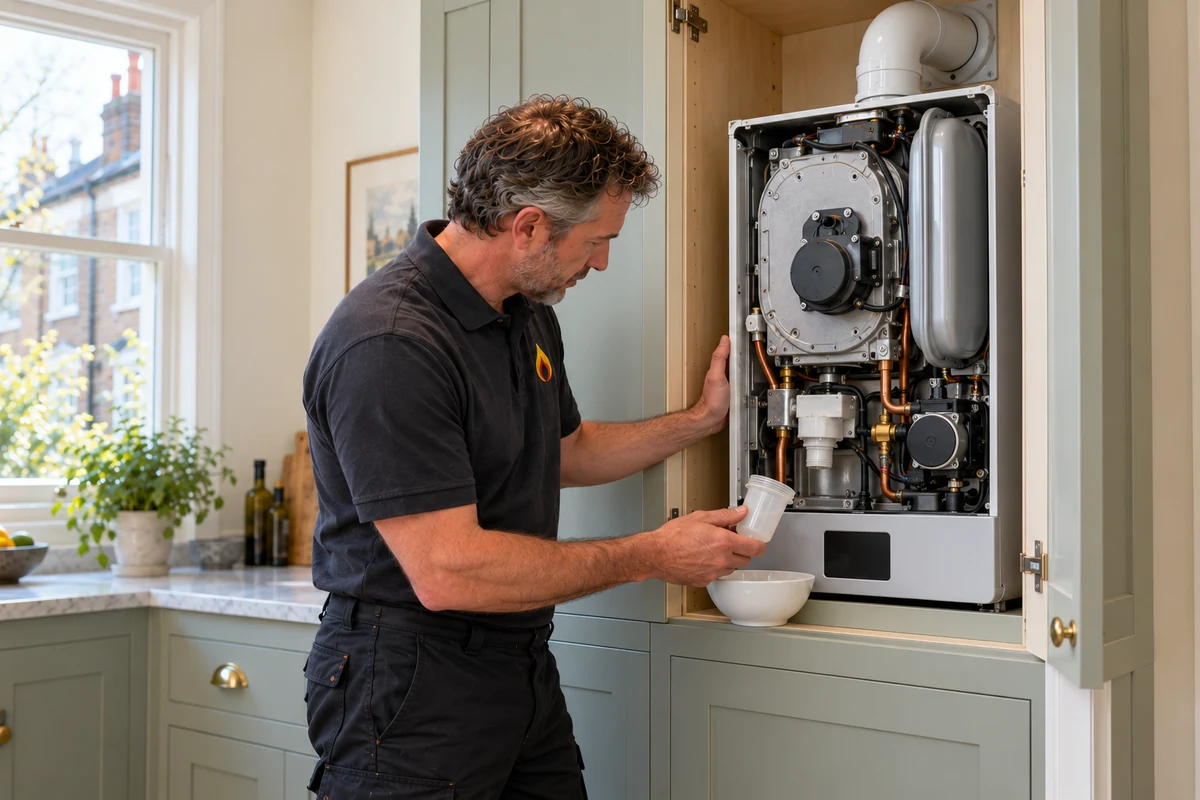
- All our engineers are Gas Safe registered
Makes we repair


How does booking an Intergas repair work, and what does it cost?
Booking: ring us any time, day or night, or send your details and we ring you back. We'll ask what the boiler is doing, and its model and any code on the display if you can see them. You don't need to know what's wrong. Finding the fault is the engineer's job. Then we tell you when an engineer can come, anywhere in Greater London.
What it costs: a repair's price depends on the part it needs, how long the job takes and when it's done. Our rates are higher in the evening, overnight and at weekends. Once the engineer has found the fault, the rate for the repair is agreed in writing before any work starts.
What happens on an Intergas repair visit?
A repair visit has three stages.
1. Before anything is touched
The engineer covers the floor around the boiler and asks what you have seen and heard since you rang.
2. Finding the fault
The engineer tells you which part has failed, whether they have it with them or must order it, and how long the work should take. No work is done until you say yes.
3. The repair
The engineer fits the part and checks the boiler runs as it should before leaving. The repair is guaranteed for 12 months, covering the parts we fit, the labour and any return visit.
What goes wrong on Intergas boilers most often?
Intergas's own help articles and user guides come back to a few problems:
- Losing pressure. Intergas names leaks at radiators, pipes or valves. An expansion vessel that has lost its charge or filled with water is another cause. The pressure then climbs as the boiler heats and drops as it cools. A pressure relief valve can drip from the pipe outside, and bleeding the radiators brings a small drop. A pressure that falls every day or every few weeks needs an engineer, not more resets.
- Not firing up, or no heating or hot water. Intergas's checklist starts with the power, the pressure and the thermostat's batteries. It goes on to the programmer's clock after a power cut, a prepayment meter's credit and radiator valves left on their frost setting.
- A frozen or blocked condensate pipe. The pipe is among the causes of F004 and F005, and of 5 on the older ranges. Intergas's user guides ask for the pipe to run inside where possible, with the boiler in a frost-free place.
- Overheating. The code is F001 on the Xclusive and Xtreme, or 1 on the older ranges. The manuals link it first to air in the system, then to the pump.
- Not lighting. F004, or 4 on the older ranges, the fault Intergas's user guides name for householders.
Whichever it is, we'll ask what Intergas's own checklist asks when you ring:
- whether the power and the gas are on
- what the pressure reads
- whether the thermostat and the programmer are calling for heat
- any code on the display
Sources: Intergas's articles 'Why does my boiler keep losing pressure?' and 'Boiler on the blink?', its user guides and its installation manuals.
Intergas fault codes and what they mean
Intergas fault codes show in two ways. The Xclusive and Xtreme show F and three figures, such as F004, on the touch screen's left display, with the service symbol flashing. The HRE, ECO RF and Rapid show a number alone, such as 4, on the main display. The red light above the reset key flashes with it.
The panels below are the Xclusive's and Xtreme's codes, each with its match on the older ranges. We'll ask for the model when you ring. Intergas's Comfort Touch room thermostat shows the boiler's codes too, which helps where the boiler is in a loft or a garage.
If a code keeps coming back after a reset, the boiler needs an engineer to look at it.
F004Intergas F004: no flame when lighting
What it means: F004 means the boiler tried to light and sensed no flame.
Possible causes, as the manual lists them:
- the gas valve, or no power reaching it from the circuit board
- low gas pressure at the boiler
- a blocked or frozen condensate drain
- the ignition module, the ignition pin, its lead or its spark gap
- no power to the ignition unit
- a poor earth to the boiler or the pin
On the HRE, ECO RF and Rapid, the same fault shows as a plain 4 on the main display. The 4 comes after four tries to light, about 15 seconds apart, with the red light above the reset key flashing. A 4 on the small service display is different, as it means the boiler is lighting and is no fault.
What you can do: see that the gas is on and reaching the boiler, and that a prepayment meter has credit. Then reset the boiler. If F004 comes back, ring us. The gas pressure, the ignition parts and the gas valve are an engineer's work.
F005Intergas F005: the flame was lost while running
What it means: F005 means the flame went out while the boiler was running.
Possible causes, as the manual lists them:
- a blocked or frozen condensate drain
- low gas pressure at the boiler
- the ignition module, pin, lead or gap
- the gas valve's setting
- the flue, with flue gases drawn back in or a blockage
- a poor earth
On the HRE and ECO RF the nearest code is 5, a weak flame signal, whose first cause is also a blocked condensate drain. On the Rapid, 5 means no flame after four restarts.
What you can do: in a frost, a frozen condensate pipe heads the manual's list. Where the pipe is at ground level and easy to reach, thaw it with warm, never boiling, water. Then reset the boiler once.
F001Intergas F001: too hot while heating
What it means: F001 means the water got too hot while the boiler was heating the radiators.
Possible causes, as the manual lists them:
- air in the system or in the boiler's heat exchanger
- the pump not running, from its power, its impeller or the pump itself
- the heating flow sensor, its wiring or its position
F002 is the same fault while the boiler makes hot water, and the manual points to the hot water sensor. On the HRE, ECO RF and Rapid the match is code 1.
What you can do: Intergas's user guides give these steps for the same fault:
- Open any radiator valves that are shut.
- Bleed the radiators.
- Top up the pressure if it is low.
- Reset the boiler.
If F001 comes back, ring us. The pump and the sensor are an engineer's work.
F003Intergas F003: the flue gases are too hot
What it means: F003 means the gases leaving the boiler through its flue got hotter than their limit.
Possible causes, as the manual lists them:
- a dirty heat exchanger, or debris in it
- a blocked flue
N202, a related notice, means the burner stopped at the flue gas limit, and the manual points to worn fins on the heat exchanger. The older HRE, ECO RF and Rapid have no matching code.
What you can do: one reset. Cleaning the heat exchanger and looking at the flue are an engineer's work.
F008Intergas F008: the fan speed is wrong
What it means: F008 means the fan isn't reaching the speed the circuit board asks for.
Possible causes, as the manual lists them:
- the fan's wiring
- the fan itself
- the circuit board
On the HRE, ECO RF and Rapid, the same fault is code 8. For code 8, the manual adds the fan catching its casing, or a poor contact. It also names a non-return valve above the fan, which has to be refitted correctly.
What you can do: one reset. The fan and its wiring are an engineer's work.
F018Intergas F018: the flue or air supply is blocked
What it means: F018 means the boiler has found its flue or its air supply blocked or restricted.
Possible causes: the flue and the air duct, with their seals and gaskets, which need looking at and cleaning.
N245, a related notice, means the fan has slowed to stop flue gases flowing back, and the manual points to the flue's non-return valve. The older HRE, ECO RF and Rapid have no matching code.
What you can do: one reset. The flue is an engineer's work, and its soundness is part of every Intergas service. If it comes back, or the flue outside looks blocked, ring us.
F010/F011Intergas F010 and F011: the heat exchanger sensor
What it means: F010 and F011 mean the circuit board has found a fault on the heat exchanger's temperature sensor.
Possible causes, as the manual lists them:
- the sensor's wiring and plug
- its reading
- its position
- a new sensor
The same sensor has two more codes in the list, F000 when it has failed and f014 when it isn't fitted properly. On the HRE, ECO RF and Rapid, sensor faults show as 10 to 14, 20 to 24, 0 or 2.
What you can do: nothing at home. A reset won't clear a sensor that is out of range, and Intergas's manual asks for its own original parts.
MoreEvery other Intergas code, in one list
Intergas's installation manuals for the Xclusive and Xtreme (84010403 and 84007408) share one list, and every code in it not covered above is here. An N code is a notice rather than a fault. The boiler's main work carries on, and the notice clears by itself once the cause has passed. If one keeps coming back, the boiler needs an engineer to look at it.
F000The heat exchanger's temperature sensor has failed
Possible causes
The sensor, which needs replacing
F002The water got too hot while the boiler was making hot water
Possible causes
The hot water sensor's wiring or position, or the sensor itself
F006A flame is sensed when there should be none
Possible causes
The gas valve, then the circuit board
F007Too little, or no, current from the flame sensor
Possible causes
Dirt on the combined ignition and sensing pin, or the pin's position or wiring
F009A fault inside the circuit board
Possible causes
The circuit board
F012The flue gas sensor has a fault
Possible causes
Its wiring, its reading or its position, then the sensor
f014The heat exchanger sensor isn't fitted properly
Possible causes
The sensor needs refitting
f015The heating flow sensor isn't fitted properly
Possible causes
The sensor needs refitting
f016The hot water sensor isn't fitted properly
Possible causes
The sensor needs refitting
F019The boiler's memory module has a fault
Possible causes
Its wiring or plug, then the module
F027The outside weather sensor has a short circuit
Possible causes
Its wiring or its reading, then the sensor
f028A reset error
Possible causes
The reset touched by accident, such as while wiping the panel, or else the circuit board
f029The gas valve has a fault
Possible causes
The gas valve's wiring and coils, then the circuit board
F031The heating flow sensor has a fault
Possible causes
Its wiring, its reading or the way it works, then the sensor
N030A notice that hot water is held back
Possible causes
A setting, or the hot water sensor
N152A notice that the boiler is running at lower output because the flue gas sensor is faulty
Possible causes
Whether the sensor is fitted, and fitted properly, its wiring, then the sensor
N202A notice that the burner stopped because the flue gases reached their limit
Possible causes
Flue gases hotter than expected, from worn fins on the heat exchanger, which may need replacing
N245A notice that the fan has slowed to stop flue gases flowing back
Possible causes
The flue gas non-return valve
The HRE, ECO RF and Rapid: every code
Intergas's manuals for the Combi Compact HRE (88287806) and the Combi Compact ECO RF (88458804) share one table of numbers. Each number shows on the main display, with the red light flashing above the reset key. The Rapid's manual (88923806) uses the same numbers, with the differences noted. The small service display's 0 to 7 are left out, as they show what the boiler is doing.
10 to 14A fault on temperature sensor S1
Possible causes
Air in the boiler, the hot water flow switch or flow sensor, the wiring, then the sensor
20 to 24A fault on temperature sensor S2
Possible causes
A break in the wiring, then the sensor
0A sensor fault found in the boiler's self-check
Possible causes
Sensor S1 or S2
0.0The water pressure is too low (on the Rapid, a pressure sensor fault)
Possible causes
The pressure needs topping up at the filling loop, or the pressure sensor is blocked
1The boiler is too hot
Possible causes
Air in the system, a stuck or stopped pump, or too little water moving round, such as radiator valves shut. On the ECO RF, a pump setting too low.
2Sensors S1 and S2 are swapped
Possible causes
The wiring, then a sensor
4No flame after four tries to light
Possible causes
The gas tap shut or no gas at the meter, the ignition pin or its gap, the burner, or an earth fault. Next come low gas pressure and no power to the gas valve or ignition, then the circuit board.
5A weak flame signal (on the Rapid, no flame after four restarts)
Possible causes
A blocked condensate drain, the gas valve's setting, or an earth fault
6A flame detection fault
Possible causes
The ignition lead and its cap, the ignition unit, then the circuit board. On the Rapid, the burner control too.
8The fan isn't at the right speed
Possible causes
The fan catching its casing, its wiring or a poor contact, then the fan
27The outside weather sensor has a short circuit
Possible causes
The sensor
29, 30The gas valve's relay is faulty
Possible causes
The ignition module, then the circuit board. On the Rapid, the burner control.
Sources, checked on 10 October 2026: Intergas's installation manuals for the Xclusive (84010403, 2021) and the Xtreme (84007408, 2021), the Xtreme's operation instructions (84009403), and the manuals and user guides for the Combi Compact HRE (88287806), the Combi Compact ECO RF (88458804) and the Rapid (88923806), from Intergas's UK website, with its help article 'Boiler on the blink?'.
How fault codes work on every make of boiler, and what each kind means.
Which Intergas boiler do you have, and how does it show a fault?
Intergas boilers show a fault in one of two ways, depending on the range. The Xclusive and Xtreme combis show F and three figures on a touch screen. The HRE, ECO RF and Rapid show a number, with a red light flashing above the reset key.
The model is on the data plate under the boiler, and we'll ask for it and the code when you ring. We repair older Intergas boilers too, such as the HR22.
Not every number is a fault. On the HRE, ECO RF and Rapid, the small service display shows what the boiler is doing, from 0 to 7. A 4 there means it is lighting, a 5 that it is heating and a 6 that it is making hot water. A 4 on the main display, with the red light flashing, is the fault that means the boiler didn't light.
On the Xclusive and Xtreme, a dash on the right display means the boiler is switched off at its panel. A flashing pressure figure means the pressure is low.
How do you reset an Intergas boiler?
Intergas boilers reset in one of two ways, as the user guides show:
- Xclusive and Xtreme: touch and hold the flashing service symbol for 2 seconds, and the boiler restarts. A reset won't clear a fault while a part is out of range.
- HRE, ECO RF and Rapid: press the reset key, the one with the red light flashing above it.
Intergas's own help article allows up to three resets, a minute apart. If the code keeps coming back, Intergas's user guides say an engineer needs to look at it.
The pressure, with the system cold:
- 1 to 1.5 bar on the Xclusive and Xtreme
- 1 to 2 bar on the HRE, ECO RF and Rapid
Low pressure has no F code on the Xclusive and Xtreme. Below 0.5 bar the pressure figure flashes and the boiler holds back. Below 0.2 bar the boiler stops answering calls for heat. To read the pressure, switch the boiler off at its panel by touching just above the power light for 2 seconds. The left display then shows the pressure.
On the HRE, ECO RF and Rapid, the pressure shows on the temperature display when the boiler is switched off. Below 0.3 bar it flashes in place of the time. The code 0.0 means low pressure, or on the Rapid a pressure sensor fault.
The user guide shows how to top up:
- Top up at the filling loop, to 1.5 bar at most on the Xclusive and Xtreme.
- Bleed the radiators.
- Look at the pressure again.
Intergas's user guides say a system that needs topping up more than a few times a year probably has a leak. If yours does, ring us.
A frozen condensate pipe stops the boiler in a frost, and a frozen drain is among the causes of F004 and F005. Where the pipe is at ground level and easy to reach, thaw it with warm, never boiling, water. Then reset the boiler. When a boiler won't fire up, and frozen condensate pipes.
Sources: Intergas's user guides and operating instructions, its installation manuals and its help article 'Boiler on the blink?'.
Is your Intergas boiler still under guarantee?
Intergas's guarantee depends on the model. Its warranty questions page gives these lengths, for parts and labour:
- 10 years on the Xclusive, Xtreme and ECO RF
- 7 years on the HRE
- 6 years on the Rapid Plus
- 3 years on the Rapid
The heat exchanger has 10 years on the Xclusive, Xtreme, ECO RF and HRE, and 7 years on the Rapid. An Intergas System Filter adds 2 years, when it is fitted with the boiler and registered with it.
The guarantee has these conditions:
- fitted by a Gas Safe registered installer, with the Benchmark checklist filled in and kept at the home
- registered within 30 days of fitting, or the cover falls to 12 months
- a service every year by a Gas Safe registered engineer to Intergas's instructions, with a record kept
- the system cleaned and flushed, with its water treatment kept up
The guarantee covers the boiler's own parts, not controls, thermostats or pumps outside it. A fault from dirty system water or from the installation is charged.
While the guarantee runs, Intergas's own engineers carry out the repairs, booked through its warranty line. Its terms leave out damage from a change or repair by anyone else that falls short of industry standards. Intergas's manual also asks for original Intergas parts.
A boiler still under its maker's guarantee is usually repaired by the maker, at no charge, so ring Intergas first. Once the guarantee has ended, or for a fault it doesn't cover, ring us. We are an independent firm, with no connection with Intergas.
Sources: Intergas's warranty questions and its warranty terms, read on 10 October 2026.
What does an Intergas boiler service cover?
Intergas asks for a service every year by a Gas Safe registered engineer, to its own instructions, and its guarantee depends on it. Intergas's current service procedure has three levels:
- Every year: a safety check with the gas and combustion readings. The condensate trap is cleaned and refilled, and the expansion vessel's charge checked. Leaks and the flue's soundness are checked too, and it all goes in the Benchmark record.
- Every second year as well: the front plate off and the heat exchanger cleaned. The burner and the ignition electrode are looked at, and the front plate's seal renewed.
- Every fourth year: a further set of seals.
We service every Intergas model, and give you the rate on the call. What a boiler service includes, check by check.
Do you cover my part of London?
Yes: we travel all over Greater London, day and night, to repair Intergas boilers in every borough, north and south of the Thames. Pick your side of the river to see the areas.
North of the river
Every borough north of the Thames: Barnet and Enfield at the top, Hillingdon in the west, Havering in the east, and central London in between.
South of the river
Every borough south of the Thames: Richmond and Kingston in the west, Bexley in the east, and down through Croydon to Sutton and Bromley.
The other makes we repair
Every main make, combi, system and regular. Pick yours for its common faults, its codes and how we repair it.















Questions about Intergas boilers
Do I need to know what's wrong with my Intergas boiler before I ring?
No. Ring and say what the boiler is doing, or what you can see or hear, and we'll ask the rest. Finding the fault is the engineer's job.
Do you charge more in the evening or at weekends?
Yes. Our rates are higher in the evening, overnight and at weekends.
Can you repair an older Intergas boiler?
Usually, yes. It depends on the boiler's condition and whether its parts are still made. We'll ask for the model when you ring.
Is my Intergas boiler worth repairing?
Often, yes. Age alone doesn't decide it. What decides it is the rate for the repair against a new boiler, and how often the boiler has failed. The engineer gives you the rate for the repair, and the choice is yours. When a new boiler makes more sense.
Will a repair affect my Intergas guarantee?
While the guarantee runs, ring Intergas first. The maker usually repairs a boiler under guarantee itself, and its terms say who may work on it. Once it has ended, any Gas Safe registered engineer can repair it.
Do you fit Intergas's own parts?
Yes, the maker's own parts wherever they are available. Each repair is guaranteed for 12 months, covering the parts we fit, the labour and any return visit.
How much does an Intergas boiler repair cost?
The cost of a repair depends on the part, how long the job takes and when it's done. The rate is agreed in writing before the repair starts. How our rates work.
What does 4 mean on an Intergas boiler?
A 4 on an Intergas boiler's main display, with the red light flashing above the reset key, is a fault. The boiler tried to light four times and found no flame, the same fault as F004 on the Xclusive and Xtreme. A 4 on the small service display is no fault, as it means the boiler is lighting. With the red light flashing, reset once. If the 4 comes back, ring us.
Why does my Intergas boiler keep losing pressure?
For an Intergas boiler that keeps losing pressure, Intergas names leaks first, at a radiator, a pipe or a valve. Next comes an expansion vessel that has lost its charge. The sign is a pressure that climbs as the boiler heats and drops as it cools. A pressure relief valve can also drip from the pipe outside, and bleeding the radiators lowers the pressure a little. If it drops every day or every few weeks, ring us.
Does an Intergas combi boiler have a diverter valve?
Intergas combis have no diverter valve, Intergas says. The hot water runs through its own circuit in the heat exchanger. Because of that, the combi has no valve motor, automatic air vent or separate plate heat exchanger either. Intergas also says its combi still gives hot water if the pump fails. If the radiators are cold while the hot water runs, ring us.
How long is the guarantee on an Intergas boiler?
The guarantee on an Intergas boiler runs from 3 to 10 years, parts and labour, depending on the model. Intergas's warranty page gives 10 years on the Xclusive, Xtreme and ECO RF, and 7 on the HRE. The Rapid Plus has 6 years and the Rapid 3. An Intergas System Filter, fitted and registered with the boiler, adds 2 years. The boiler must be registered within 30 days of fitting and serviced every year.
Who makes Intergas boilers?
Intergas boilers are made by Intergas, a Dutch company founded in 1939, with its head office at Coevorden in the Netherlands. Intergas opened its UK office in 2008, and Rheem has owned it since 2019. Companies House names Paloma Rheem Global, of Japan, as the ultimate parent of its UK company, Intergas Heating Limited.
Don't know what has failed? You don't have to.Ring and say what you can see or hear. Finding the fault is our job.
Calls answered 24 hours a day
A real person answers and gives you the rate on the call. No work starts until you say yes, and repairs are guaranteed for 12 months: parts, labour and any return visit.