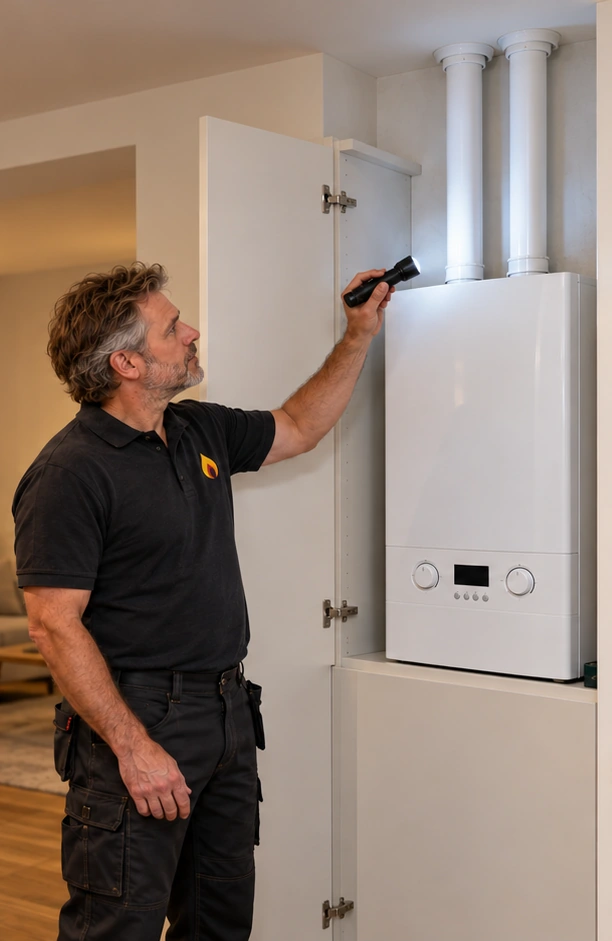

Keston boiler repair in London
We repair current and older Keston boilers. Ring us, day or night.
- Keston Combi 2 and C30 repaired
- All our engineers are Gas Safe registered
Makes we repair


How does booking a Keston repair work, and what does it cost?
Booking: ring us any time, day or night, or send your details and we ring you back. We'll ask what the boiler is doing, and its model and any code on the display if you can see them. You don't need to know what's wrong. Finding the fault is the engineer's job. Then we tell you when an engineer can come, anywhere in Greater London.
What it costs: a repair's price depends on the part it needs, how long the job takes and when it's done. Our rates are higher in the evening, overnight and at weekends. Once the engineer has found the fault, the rate for the repair is agreed in writing before any work starts.
What happens on a Keston repair visit?
A repair visit has three stages.
1. Before anything is touched
The engineer covers the floor around the boiler and asks what you have seen and heard since you rang.
2. Finding the fault
The engineer tells you which part has failed, whether they have it with them or must order it, and how long the work should take. No work is done until you say yes.
3. The repair
The engineer fits the part and checks the boiler runs as it should before leaving. The repair is guaranteed for 12 months, covering the parts we fit, the labour and any return visit.
What goes wrong on Keston boilers most often?
Keston's own guides and news posts come back to the same problems:
- A frozen condensate pipe. Keston calls it one of the commonest problems in winter. The boiler gurgles, then locks out. A Combi 2 shows Blocked Flue/Condensate, then Ignition Lockout. A System S30 shows L2 or F2, and a Heat 2 a fault from 52 to 58.
- Losing pressure. Small leaks at joints, most often round radiator valves, air escaping through automatic air vents, or a pressure relief valve letting water by. If topping up doesn't hold, it needs an engineer.
- Air in the radiators. Keston's winter advice is to bleed them. If no air hisses out, the pressure may already be low.
- The flue. A twin-flue boiler's air and flue pipes can run a long way. A moved joint, a slipped support or a terminal blocked by a nest or the weather affects how the boiler burns.
- No heating, no hot water or a blank display. The cause is often the power, the mode, the programmer or the room thermostat, which the user guide's chart covers. Boiler Off on the screen needs an engineer.
Whichever it is, we'll ask what the boiler is doing when you ring.
Keston fault codes and messages, and what they mean
A Keston Combi 2 or System 2 shows no codes. Instead, it names the fault in words, with steps and a Restart key where a restart is allowed. The messages are the same as on Ideal's Logic+ Combi2.
A Combi C shows the same faults over two to four screens. A System S30 shows a code, given in brackets below, and a Heat 2 shows Fault and a number.
Five restarts in 15 minutes bring up Too Many Restarts. A message that keeps coming back needs an engineer.

Ignition LockoutKeston Ignition Lockout (L2 on a System S30)
What it means: The boiler tried to light five times and failed, so it locked out.
Possible causes, as the manual lists them:
- If it lights for a moment and goes out: the flame-sensing electrode and its lead, a blocked condensate pipe, then the gas valve.
- If it doesn't light at all: the gas pressure reaching the boiler, the power to the gas valve, the valve itself, then the spark parts.
In winter, a frozen condensate pipe is the common cause. On a Heat 2 it shows as a fault from 52 to 58.
What you can do:
- See that your other gas appliances work and a prepayment meter has credit.
- Thaw a frozen condensate pipe at ground level with warm water.
- Press Restart.
Flame LossKeston Flame Loss (F2 on a System S30)
What it means: The flame went out while the boiler was running.
Possible causes, as the manual lists them:
- the flame-sensing electrode, the condensate pipe or a blocked flue
- the gas pressure, the power to the gas valve, the spark parts and the condensate trap
- the gas valve
What you can do: check your other gas appliances work, the gas is on at the meter and a prepayment meter has credit. The screen offers no restart for it, so if those are fine, ring us.
Low Water PressureKeston Low Water Pressure (F1 on a System S30)
What it means: The pressure has fallen too low, and below 0.3 bar the boiler stops.
Possible causes, as the manual lists them:
- the system not full, or a valve closed
- a loose connection at the pressure sensor, then the sensor
Keston's own list of why the pressure drops:
- small leaks at joints, most often round radiator valves
- air escaping through automatic air vents
- a pressure relief valve letting water by
What you can do: with the boiler off and the system cold:
- Top up to 1.0 bar, as the user guide shows.
- Bleed the radiators.
- Top up again.
If the pressure won't rise, or keeps falling, ring us. A leak is likely.
OverheatKeston Overheat (L1 on a System S30)
What it means: The water in the boiler got too hot, so it locked out. A Combi C shows Overheat Lockout.
Possible causes, as the manual lists them:
- the system not full, or the isolation, filter or radiator valves closed
- a pump that is stuck, when the water coming back is far colder than the water leaving
- the flow and return sensors
What you can do: follow the screen's steps.
- Top up to 1.0 bar with the system cold.
- Bleed the radiators and top up again.
- Open any closed radiator valves.
- Restart once.
No Water FlowKeston No Water Flow (Combi 2 and System 2)
What it means: The boiler can't sense water moving through it. The screen's steps point to low pressure or air in the system. Three related messages, Pump Dry Run, Pump Rotor Blocked and Pump Fault, point to the pump. On a System S30, No Water Flow shows as L1, beside the overheat. On a Heat 2, it shows as fault 50 or a fault from 67 to 72.
What you can do: with the system cold, top up to 1.0 bar, bleed the radiators and top up again. The screen offers no restart for it, so if it stays, ring us.
Too Many RestartsKeston Too Many Restarts (LC on a System S30)
What it means: The boiler has been restarted five times in 15 minutes and won't take another. Too Many Restarts isn't the fault itself. Whatever kept locking the boiler out, often an ignition lockout, is still there. On a Heat 2, fault 66 is the same thing from a remote control.
What you can do: on a Combi C or a System S30, turn the power off and on at the fused spur. Their user guides give that step, while the Combi 2's screen sends you to an engineer. Either way, ring us, as the fault behind it needs an engineer.
L2Keston L2: the boiler tried to light and locked out
What it means: The boiler tried to light and locked out.
Every cause of L2, and what fixes it, is on the L2 fault code page.
F1Keston F1: the water pressure is too low for the boiler to run
What it means: The water pressure is too low for the boiler to run.
Every cause of F1, and what fixes it, is on the F1 fault code page.
F2Keston F2: the flame went out while the boiler was running
What it means: The flame went out while the boiler was running.
Every cause of F2, and what fixes it, is on the F2 fault code page.
MoreEvery other Keston code, in one list
Every other message in Keston's user guide for the Combi 2 and System 2, the boilers made since 2023, is in this list. The older Combi C adds two, at the list's foot. The words on each code are what the screen shows.
Flame On Before Gas OnThe boiler sensed a flame before it opened the gas valve
The usual cause
The wiring inside the boiler, or a worn flame-sensing electrode
Flow Thermistor FaultThe sensor on the water leaving the boiler reads out of range
The usual cause
The sensor or its wiring, then the main board
Return Thermistor FaultThe sensor on the water coming back reads out of range
The usual cause
The sensor or its wiring, then the main board
DHW Thermistor FaultThe hot water sensor reads out of range
The usual cause
The sensor or its wiring
Outside Sensor FaultThe outside temperature sensor has failed
The usual cause
The sensor or its wiring
Fan FaultThe fan isn't running as the main board expects
The usual cause
The fan's wiring, the fan, or the main board
Gas Valve FaultThe gas valve isn't working as it should
The usual cause
The gas valve or its wiring
Blocked Flue/CondensateThe flue or the condensate pipe is blocked
The usual cause
A blocked or frozen condensate pipe, or a blocked flue
Pump Rotor BlockedThe pump is jammed
The usual cause
A blockage in the pump
Pump Dry RunThe pump is running without enough water
The usual cause
Low pressure, or air in the system
Pump FaultThe pump has failed
The usual cause
The pump or its wiring
PCB FaultThe main board isn't set up, or is faulty
The usual cause
The main board
Spare PCB Not SetA new main board hasn't been set up for the boiler
The usual cause
The board's set-up after a repair
Low Mains VoltageToo little electricity is reaching the boiler
The usual cause
The electricity supply to the home
Room Thermostat FaultA fault with the room thermostat
The usual cause
The thermostat's batteries, or its wiring
High Mains Voltage (Combi C)Too much electricity is reaching the boiler
The usual cause
The electricity supply to the home
Flow/Return Reversed (Combi C)The flow and return readings are the wrong way round
The usual cause
The return sensor
The System S30, the Heat 2 and older Kestons (C36, C45 family, Qudos, Celsius 25): their codes
The System S30, from Keston's user guide. L1, L2, LC, F1 and F2 are the faults in depth above.
F3Fan fault
The usual cause
The fan, its wiring or the main board
F4 or L4The flow sensor has failed
The usual cause
The sensor or its wiring
F5 or L5The return sensor has failed
The usual cause
The sensor or its wiring
F6The outside sensor has failed
The usual cause
The sensor or its wiring
F7Too little electricity is reaching the boiler
The usual cause
The electricity supply to the home
F9 or L9The main board isn't set up
The usual cause
The main board
L6A flame sensed before the gas valve opened
The usual cause
The wiring inside, or the flame-sensing electrode
FUThe water coming back is more than 50 degrees cooler than the water leaving
The usual cause
Closed valves, the pump, or a blockage in the system
The Heat 2, from Keston's user guide. The list gives each fault's number, what it means and what the boiler does about it.
1 to 6A flow, return or flue sensor's circuit is open or shorted
What the boiler does
Waits and tries again, but 5 is a warning
7 to 9The hot water sensor's circuit is open or shorted, or the outside sensor has failed
What the boiler does
Warns and keeps running
10The water pressure sensor has failed
What the boiler does
Waits and tries again
11 to 18A flow, return, flue or heat sensor's circuit is open or shorted
What the boiler does
Locks out after 24 hours
19, 20The heat sensor's circuit is open or shorted
What the boiler does
Waits and tries again
21 to 24The header or room sensor's circuit is open or shorted
What the boiler does
Warns and keeps running
30 to 32The flow, the return or the flue is too hot
What the boiler does
Waits and tries again
33The flow and return are the wrong way round
What the boiler does
Waits and tries again
34, 35The sensors' fit on the pipes failed its check
What the boiler does
34 waits, and 35 locks out
36, 38The flow is rising too fast, or the flow and return are too far apart
What the boiler does
Waits and tries again
39, 40The flow or the return overheated
What the boiler does
Locks out
41The flue overheated, or the thermal fuse has gone
What the boiler does
Locks out
42The heat exchanger is too hot
What the boiler does
Waits and tries again
50No heating water is moving
What the boiler does
Waits and tries again
51The water pressure is low
What the boiler does
Waits and tries again
52 to 58No flame at the start, the flame lost while running or settling, a flame where there shouldn't be, or no flame after its restarts. Keston links these to a frozen condensate pipe.
What the boiler does
52, 53 and 55 warn and try again, while 54, 56, 57 and 58 lock out
59 to 62The fan is turning when it shouldn't, or its speed is wrong
What the boiler does
59 and 61 wait, then lock out. 60 locks out, and 62 warns.
63, 64The mains voltage is too high, or too low
What the boiler does
63 warns, and 64 waits
65Contact with an OpenTherm control is lost
What the boiler does
Warns
66Too many resets from a remote control
What the boiler does
Locks out
67 to 72No water flow, or a pump fault: jammed, electrical, running dry
What the boiler does
Waits and tries again
73 to 81The cascade link, the safety interlock or the air pressure switch, or the water pressure too high. The water flow too low or too high, or an outside input.
What the boiler does
Most wait or warn, but 75 and 78 can lock out
93 to 99A fault inside the control board or its settings
What the boiler does
Most lock out
Older Kestons number their codes range by range, so one code can mean different things. E44 is low pressure on a C45 and a sensor fault on a C36.
Each list below comes from that range's own manual. The last part of each code is the manual's list, mostly the engineer's checks, with the user's step where the manual gives one. We'll ask for the model when you ring.
Keston C36 and C36P Combi (installation and servicing instructions WD388/0/2004). The C36 flashes E and two figures. The user's section lists nine codes, and the engineer's chapter the rest. Once the cause is put right, the Reset button restarts it. Switching the power off and on doesn't clear a lockout. If the code comes back, the boiler needs an engineer. The manual sets the pressure at 1.0 to 2.0 bar, shown on the display by pressing Installer until 5 appears.
E01Ignition failure: five tries to light, no flame, so it has locked out
What the manual lists
User's list: the gas is on. Engineer's checks: the air supply, the flue, the igniter and its spark gap
E02A false flame: a flame sensed before the boiler lit
What the manual lists
User's list: possibly the electricity supply. Engineer's checks: the gas valve closing, the polarity, the voltage and the earth
E03The boiler overheated
What the manual lists
User's list: closed heating valves, air in the system, the pressure. Engineer's checks: a blockage, the bypass and the pump
E05Fan failure: the boiler can't sense the fan turning
What the manual lists
The fan and both of its connectors
E07The flue overheated
What the manual lists
The combustion, and the flue temperature against the return. Possibly the heat exchanger.
E08A fault in the flame circuit
What the manual lists
Possibly the control box
E09A fault driving the gas valve
What the manual lists
The gas valve or the control box
E10A control box error
What the manual lists
Possibly the control box
E11The automatic check of the flow and return sensors failed
What the manual lists
Each sensor on its right pipe, reading correctly
E12 to E22Control box errors
What the manual lists
Possibly the control box
E23A fault while filling with water
What the manual lists
The water pressure sensor
E24The pressure has been lost, and topped up, more than four times in 24 hours: a likely leak
What the manual lists
The system and the boiler, for a leak
E25A control box error
What the manual lists
Possibly the control box
E26The flame dropped out five times in four minutes: an unstable flame
What the manual lists
User's list: the flue and air terminals, a blocked or frozen condensate drain, a low LPG supply. Engineer's checks: the combustion, gas, air and flue
E30The flow sensor is short-circuited
What the manual lists
Its connections
E31The flow sensor's circuit is open
What the manual lists
Its connections
E32The hot water sensor is short-circuited
What the manual lists
Its connections
E33The hot water sensor's circuit is open
What the manual lists
Its connections
E34The mains voltage is below 180 volts
What the manual lists
The electricity supply to the home
E35The mains frequency is wrong
What the manual lists
The electricity supply to the home
E37A water pressure error: the system needs topping up
What the manual lists
User's list: top up. Engineer's checks: the pressure and the pressure sensor
E38A fault with the reset key
What the manual lists
The fascia board
E40The water pressure is too high
What the manual lists
The expansion vessel's charge and working
E41No communication between the fascia and the control box
What the manual lists
The cables between them
E43The return sensor is short-circuited
What the manual lists
Its connections
E44The return sensor's circuit is open (on a C45, E 44 is low pressure)
What the manual lists
Its connections
E45The flue sensor is short-circuited
What the manual lists
Its connections
E46The flue sensor's circuit is open
What the manual lists
Its connections
E99The same fault as E41
What the manual lists
The cables between the fascia and the control box
Keston C45, C40P, C55 and C55P (installation and servicing instructions WD536). In normal running, the C45 family shows a status figure and the flow temperature:
- 0: standby
- 1: the fan before lighting
- 2: lighting
- 3: heating
- 4: hot water
- 5 and A: adjusting
- 6: up to temperature
- 7 and 8: the pump running on
A B code is a wait. The boiler holds off for a set time, the code taking turns with 9 and the flow temperature, then tries again. An E code is a lockout that waits for the Reset button. The display prints a space after the letter, so E 44 is E44.
B 18A wait: the flow is above 95 degrees
What the manual lists
The boiler holds off, then tries again
B 19A wait: the return is above 95 degrees
What the manual lists
The boiler holds off, then tries again
B 24A wait: the return is hotter than the flow
What the manual lists
The pump's direction, on the boiler and any other pumps, and crossed sensor wires
B 25A wait: the flow is heating up too fast
What the manual lists
An air lock, or a blockage in the circulation
B 26A wait: the water pressure is low
What the manual lists
The pressure
B 28A wait: no signal from the fan
What the manual lists
The fan unplugged or faulty
B 29A wait: the fan's signal is wrong
What the manual lists
The fan
B 30A wait: the flow and return are too far apart
What the manual lists
The water's circulation
B 65A wait for the fan to start
What the manual lists
The boiler holds off, then tries again
E 00Lockout: a flame sensed when none was expected
What the manual lists
The boiler's earth and the flame probe
E 02Lockout: no ignition after a restart
What the manual lists
The gas supply, the gas valve and the igniter's spark
E 03Lockout: the gas valve is faulty or unplugged
What the manual lists
The gas valve
E 04Lockout: the power was reset while the boiler was locked out
What the manual lists
A lockout waits for the Reset button
E 11Lockout: an error in the internal electronics
What the manual lists
The control box, reset or replaced
E 12Lockout: the thermal fuse has blown, or the flue overheat thermostat has tripped
What the manual lists
The thermal fuse or the flue thermostat
E 18Lockout: the flow overheated
What the manual lists
The water's circulation
E 19Lockout: the return passed its highest temperature
What the manual lists
The circulation
E 25Lockout: the flow heated up too fast
What the manual lists
The water's circulation
E 28Lockout: the fan isn't turning
What the manual lists
The fan's connection and the fan
E 30Lockout: the flow and return are too far apart
What the manual lists
The circulation
E 31Lockout: the flow sensor is short-circuited
What the manual lists
Its connections, or the sensor
E 32Lockout: the return sensor is short-circuited
What the manual lists
Its connections, or the sensor
E 36Lockout: the flow sensor's circuit is open
What the manual lists
Its connections, or the sensor
E 37Lockout: the return sensor's circuit is open (on a C36, E37 is low pressure)
What the manual lists
Its connections, or the sensor
E 44Lockout: the water pressure is low (on a C36, E44 is a sensor fault)
What the manual lists
The pressure
Keston Qudos 28h, 28hP, 28s and 28sP (instructions WD440/3/2007 and WD420/3/2007). The Qudos flashes E and two figures. Its user's list and its engineer's table don't always agree, so both readings are given. The 28h and 28s manuals also differ on the pressure codes. A code marked Service Reset Required won't clear from the front Reset button. An engineer resets it on the main board. For the rest, once the cause is put right, the Reset button restarts the boiler. Switching the power off and on clears neither kind. If the code comes back, the boiler needs an engineer.
E01Lockout in the flame sequence
What the manual lists
Possibly the board or the electricity supply
E02Ignition lockout: five tries to light failed
What the manual lists
User's list: the gas is on. Engineer's checks: the gas supply, the igniter and spark gap, the flue and air pipes, the condensate drain, the gas valve
E03The spark gap is too small, or the gas valve is faulty
What the manual lists
The gas valve's connections and solenoids
E04The flame was lost five times in one call for heat
What the manual lists
User's list: an engineer, for the flue, the gas supply or a blocked condensate drain. Engineer's checks: the combustion settings and the igniter
E12The flow overheated
What the manual lists
User's list: an open bypass and working controls. Engineer's checks: the circulation, the pump and the flow sensor
E20The fan can't reach its lighting speed
What the manual lists
The fan, and anything catching its impeller
E24The return is more than 10 degrees hotter than the flow
What the manual lists
The direction of circulation, and the flow and return sensors
E25The temperature is rising too fast
What the manual lists
A blockage, or the pump
E26Low water pressure, in the user's lists (the 28s's pairs it with E67). In the engineer's tables, the pressure sensor is unplugged.
What the manual lists
User's list: on a sealed system, top up to between 1 and 2 bar until the code clears. Topping up again and again means a leak.
E28A fan fault
What the manual lists
The fan's connector
E31The flow sensor is short-circuited
What the manual lists
Its wiring
E32The return sensor is short-circuited
What the manual lists
Its wiring
E33The hot water sensor is short-circuited, where one is fitted
What the manual lists
Its wiring
E35The flue sensor is short-circuited
What the manual lists
Its wiring. Service Reset Required.
E36The flow sensor's circuit is open
What the manual lists
Its wiring
E37The return sensor's circuit is open
What the manual lists
Its wiring
E38The hot water sensor's circuit is open, where one is fitted
What the manual lists
Its wiring
E40The flue sensor's circuit is open
What the manual lists
Its wiring. Service Reset Required.
E52The flue overheated
What the manual lists
The combustion and the heat exchanger. Service Reset Required.
E62The water pressure is too high: above 2.7 bar on a 28s (the 28h's engineer table doesn't list it)
What the manual lists
User's list: a filling valve left open, or the expansion vessel (on a 28h, the open vent too)
E67The water pressure is too low: below 0.2 bar on a 28h, below 0.4 bar on a 28s
What the manual lists
Top up, as for E26
E70The cabinet overheated: the thermal fuse will need replacing
What the manual lists
User's list: an engineer before the boiler runs again. Engineer's checks: hot gasket joints and the combustion. Service Reset Required.
E73A code plug error
What the manual lists
The loom and its connections to the main board
E74The mains voltage is below 190 volts
What the manual lists
The electricity supply
E75The mains voltage is above 270 volts
What the manual lists
The electricity supply
E76The solar panel sensor is short-circuited, where one is fitted
What the manual lists
That sensor
E77The solar panel sensor's circuit is open, where one is fitted
What the manual lists
That sensor
E95The solar tank sensor is short-circuited, where one is fitted
What the manual lists
That sensor
E96The solar tank sensor's circuit is open, where one is fitted
What the manual lists
That sensor
Keston Celsius 25 and 25P (installation and servicing instructions WD209/1/2000). The Celsius 25 shows faults with lights. A red lockout light flashes a set number of times every two seconds. A green light, numbered 1 to 4, names the part. The manual's own pages differ on low pressure. Its description of the control sequence gives three red flashes. Its engineers' table and its fault chart give four, and three for a sensor, as below.
All lights offNo power to the boiler
What the manual lists
The electricity supply
Green mains light flashing fastStatus, not a fault: the boiler is off at its control knob
What the manual lists
Turn the knob on
Green mains light flashing slowlyStatus, not a fault: the outside controls aren't calling for heat
What the manual lists
Nothing wrong with the boiler
Red once, green 1 onLockout: the flow overheat thermostat tripped
What the manual lists
Reset with the knob, off then on. Engineer's checks: the circulation and the bypass
Red once, green 2 onLockout: the cabinet got too hot
What the manual lists
Engineer's checks: the thermal fuse link replaced, heat leaking from gaskets, the pump and fan running on
Red once, green 3 onLockout: the flue overheat thermostat tripped
What the manual lists
Engineer's checks: the thermostat reset, and the flue temperature with the boiler firing
Red once, green 4 onA wiring loom fault, on a spare sensor connection
What the manual lists
The wiring loom
Red twice, green 1 onLockout: five tries to light failed
What the manual lists
The user's step: the knob off for 10 seconds, then on. If it locks out again at once, the gas supply, then an engineer. Engineer's checks: the spark gap, gas pressure, flue or air, condensate trap, igniter and ignition board
Red twice, green 2 onLockout: the flame went out while running
What the manual lists
The condensate trap, a flue or air blockage, the combustion
Red three times, green 1 onThe flow sensor is unplugged or faulty
What the manual lists
The sensor and its wiring
Red three times, green 2 onThe return sensor is unplugged or faulty
What the manual lists
The sensor and its wiring
Red four timesThe water pressure is low, below 0.2 bar (section 5.1 gives three flashes for this)
What the manual lists
On a sealed system, topped up, and the boiler checked for leaks
Red five timesThe fan's speed has dropped below 500 rpm
What the manual lists
The fan, its connections and its board
Red flashing constantlyThe fan's board is faulty
What the manual lists
The fan board
Red 15 times, then a pauseA fault the chart sends to the control board
What the manual lists
Reset with the knob, off then on. If it stays, the control board.
Red pump light flashing slowlyThe pump can't move enough water through the boiler
What the manual lists
A restriction in the system. Possibly an extra pump.
Red pump light flashing fastThe pump can't slow the water enough
What the manual lists
Regulating valves on the system
Which Keston boiler do you have, and how does it show a fault?
Keston makes twin-flue boilers, with two narrow pipes. One brings air in and one takes the flue gases out, so a Keston can sit well inside a flat, far from an outside wall. The newer combis name a fault in words, while older Kestons show a code or a light. We'll ask for the model and what the display shows when you ring.
Not every message is a fault. These messages show what a Combi 2 is doing:
- Ready
- Preheat Active
- Hot Water Priority
- Boiler Frost Protection Active
- Room Thermostat or Timer Off
Service Due means a service is due. On a Heat 2, a number marked as a warning keeps the boiler running. We'll ask what the display shows.
How do you reset a Keston boiler?
Each Keston range restarts its own way, as its user guides show:
- Combi 2 and System 2: press Restart when the fault screen shows it, and the boiler runs its lighting sequence again.
- Combi C30 and C35: press the Restart button when the screen says to.
- The older Combi 30 and 35: turn the mode knob to reset and straight back.
- Heat 2: a lockout needs the reset button, pressed while the fault shows. A warning or a wait needs no reset.
- After five restarts in 15 minutes (Too Many Restarts): turn the power off and on at the fused spur.
If the fault comes back after one restart, ring us rather than restarting again.
The pressure: with the system cool, it should be 1 to 1.5 bar. At 0.5 bar or less it needs topping up, and below 0.3 the boiler stops.
On a Combi 2 the gauge is behind the drop-down door, and the user guide shows how to top up at the filling loop. If the pressure won't rise, or keeps falling, ring us.
A frozen condensate pipe can be thawed where it is at ground level and easy to reach:
- Find the frozen spot, often at the open end, a bend or a dip.
- Warm it with a hot water bottle, a warm cloth or warm, never boiling, water.
- Restart the boiler.
In a cold spell, Keston suggests turning the boiler's heating setting to its highest. It also suggests leaving the heating on overnight, with the room thermostat at 15 degrees. When a boiler won't fire up, and frozen condensate pipes.
Is your Keston boiler still under guarantee?
Keston's warranty depends on the range:
- The Combi 2 and System 2 have 5 years, or 7 when fitted with a Keston System Filter. The Combi C and System S30 have the same.
- The Heat 2 has 2 years. It has 5 years when a Keston engineer commissions it, and a Gas Safe engineer trained on Keston's boilers services it every year.
The boiler must be registered within 30 days of fitting, or the warranty falls to 12 months. It must also be serviced by a Gas Safe registered engineer every 12 months, or the warranty lapses.
While the warranty runs, Keston sends an engineer or a contractor it appoints. Its terms leave out faults caused by a repair or a change by someone else that doesn't fully meet industry standards. Keston may also charge a call-out when the cause is outside the boiler.
Ideal Heating's customer safety notice of 2024, which Keston published too, offers a free safety upgrade. The upgrade is for Keston Combi 2 and System 2 boilers made between August 2022 and 7 January 2024. In rare cases, air trapped during a fault could make one overheat and fail, so an engineer adds a safety device. The notice says how to find out whether yours is one, and that the boiler can be used meanwhile. Keston Heat boilers, and boilers made today, aren't affected.
A boiler still under its maker's guarantee is usually repaired by the maker, at no charge, so ring Keston first. Once the guarantee has ended, or for a fault it doesn't cover, ring us. We are an independent firm, with no connection with Keston.
What does a Keston boiler service cover?
Keston asks for a service at least once a year by a Gas Safe registered engineer, and its warranty depends on it. The manual's checklist matches Ideal's Logic+:
- a flue gas reading
- a full clean of the burner, the fan, the heat exchanger and the condensate trap when the reading is high
On a twin-flue boiler, Keston stresses both pipes along their whole run. The checks cover the joints, the supports, the slope and clear terminals, since nests and the weather can block them. Keston suggests a service in autumn, before the cold. Service Due on a Combi 2 or System 2, or Service required on a Combi C, means one is due.
We service every Keston model, and give you the rate on the call. What a boiler service includes, check by check.
Do you cover my part of London?
Yes: we travel all over Greater London, day and night, to repair Keston boilers in every borough, north and south of the Thames. Pick your side of the river to see the areas.
North of the river
Every borough north of the Thames: Barnet and Enfield at the top, Hillingdon in the west, Havering in the east, and central London in between.
South of the river
Every borough south of the Thames: Richmond and Kingston in the west, Bexley in the east, and down through Croydon to Sutton and Bromley.
The other makes we repair
Every main make, combi, system and regular. Pick yours for its common faults, its codes and how we repair it.
















Questions about Keston boilers
Do I need to know what's wrong with my Keston boiler before I ring?
No. Ring and say what the boiler is doing, or what you can see or hear, and we'll ask the rest. Finding the fault is the engineer's job.
Do you charge more in the evening or at weekends?
Yes. Our rates are higher in the evening, overnight and at weekends.
Can you repair an older Keston boiler?
Usually, yes. It depends on the boiler's condition and whether its parts are still made. We'll ask for the model when you ring.
Is my Keston boiler worth repairing?
Often, yes. Age alone doesn't decide it. What decides it is the rate for the repair against a new boiler, and how often the boiler has failed. The engineer gives you the rate for the repair, and the choice is yours. When a new boiler makes more sense.
Will a repair affect my Keston guarantee?
While the guarantee runs, ring Keston first. The maker usually repairs a boiler under guarantee itself, and its terms say who may work on it. Once it has ended, any Gas Safe registered engineer can repair it.
Do you fit Keston's own parts?
Yes, the maker's own parts wherever they are available. Each repair is guaranteed for 12 months, covering the parts we fit, the labour and any return visit.
How much does a Keston boiler repair cost?
The cost of a repair depends on the part, how long the job takes and when it's done. The rate is agreed in writing before the repair starts. How our rates work.
Why does my Keston boiler keep losing pressure?
For a Keston boiler that keeps losing pressure, Keston names these causes:
- small leaks at joints, most often round radiator valves
- air escaping through automatic air vents
- a pressure relief valve letting water by
Top up to 1 to 1.5 bar as the user guide shows. If the pressure keeps falling, ring us.
What does Ignition Lockout mean on a Keston boiler?
Ignition Lockout on a Keston boiler means the boiler tried to light five times and failed. In winter, a frozen condensate pipe is the common cause. Otherwise, it is the gas supply or the parts that light the flame. Thaw a frozen pipe at ground level with warm, never boiling, water, and press Restart once. If the boiler locks out again, ring us.
What is a twin-flue boiler?
A twin-flue boiler has two narrow pipes, one bringing air in and one taking the flue gases out. With them, the boiler can sit far from an outside wall. Every Keston is one. On a repair or a service, the engineer checks both pipes along their whole run.
Who makes Keston boilers?
Keston is Ideal Heating's brand, made at Ideal's site in Hull since 2013. Keston's first parent company was set up in 1928. Keston's current combis show the same messages as Ideal's Logic+. How we repair Ideal boilers.
Don't know what has failed? You don't have to.Ring and say what you can see or hear. Finding the fault is our job.
Calls answered 24 hours a day
A real person answers and gives you the rate on the call. No work starts until you say yes, and repairs are guaranteed for 12 months: parts, labour and any return visit.